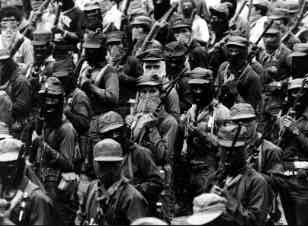
Although the Federal Army had clashed with a small armed group in the Lacandona Forest the previous summer, the Mexican government, at that point trying to convince the U.S. Congress of its internal stability in order to get the North American Free Trade Agreement passed, had denied the existence of a guerrilla movement in Chiapas. Now, on the very day the NAFTA came into force, a small force of men and women wearing scruffy wellies and armed with peashooters had declared war on the government. In the poorest state a group of indigenous people were claiming the right to defend themselves against a government and a social order which offered them nothing and wanted their land.
The rebels caught the imagination of the world. They quickly withdrew from the towns they had taken, making a stand only in Ocosingo, where they had to fight their way out of a Federal Army trap . The behaviour of the official forces contrasted with the Zapatistas' apparent disinterest in killing, but national and international protests forced the government to agree a truce on the 12th of January (1994). Samuel Ruiz, the Catholic bishop of San Cristóbal, Chiapas, offered to mediate. He described the rebels as follows:
The Zapatistas do not want to represent all the people of Mexico, but rather to make an appeal to the whole nation from the perspective of the marginalized indigenous people -- so that all sectors of Mexican society can participate in building a better country ... after all this is over, the Zapatistas do not want to become a political party or a movement. Rather, they want those in power to open the system to the participation of all. They want power to no longer be based on domination, but on service and participation.
The rebels, it turned out, had been organising in the jungle for ten years. The supreme command rests not with a general or a Chairman, but with the Indigenous Revolutionary Clandestine Committee (CCRI), a large body made up of delegates from all the Zapatista communities. The delegates are in turn bound to reflect the wishes of the village assemblies, open forums where everything from land use to war on the government is declared. The EZLN are the first grass roots controlled army of the 20th century - perhaps of any century? In addition, 35% of the Zapatista Army are women, who are treated as complete equals by their male comrades - as required by the Women's Revolutionary Law.
The poetic communiqués of the EZLN, usually issued by enigmatic spokesman Subcommandante Insurgente Marcos, and the empowering sight of the Zapatistas, who always appear masked either by balaclavas or bandanas, taking on the powers that be with the power of the imagination and guns that had been begged, borrowed or stolen, brought the world's press and television reporters to Chiapas. But in February 1995 the government, under pressure to crush the rising before it spread (Chase Manhattan Bank sent them a memo 'advising' that future investment would depend on the elimination of the Zapatista challenge), rushed forty thousand troops into Chiapas.
After another storm of protest, including demonstrations of over 100,000 in the capital and protests to Mexican embassies throughout the world, the offensive was halted. But although the peace process has resumed, and even made some progress, at least on paper, the troops remain. Often camped right beside a village, they and the police carry on a 'low-intensity' war against the peasants who dared to challenge the government. International human rights monitors from groups as respected as AMNESTY INTERNATIONAL and Human Rights Watch have documented many cases of unlawful detention, torture, rape and murder. The systematic abuse of human rights, prevalent throughout the country, is compounded by the massive army presence.
In the face of this provocation, the EZLN have continued resolute in their search for justice, rebuilding what has been destroyed and looking for new ways to tackle the old oppression. On New Year's Day 1996, two years after they hit the headlines, they announced the birth of the Zapatista Front for National Liberation (FZLN), a movement open to all not affiliated to a political party, seeking to write a new constitution for a new nation. Although the EZLN do not intend to give up their guns, the new FZLN is to be an unarmed organisation, based on but not controlled by the EZLN. And its aims go further than reform of Mexican society. The Zapatistas have issued an invitation to the world to join them in the Lacandona Forest for a World Meeting of people struggling against neoliberal economic and social politics (Thatcherism and Reaganomics for the 90s). It could be the start of something big ...